Two casts have been taken of my head; one in 1833, and one in 1853. They were taken purely for phrenological purposes. As I have bequeathed my skull and brain, for the same objects, I should not have thought it necessary to have a second cast taken, (to verify the changes made by time) but for the danger of accident which might frustrate my arrangements. I might die by drowning at sea; or by a railway smash, which would destroy the head: so I made all sure by having a cast taken, not long before my last illness began.
Tuesday, 23 October 2012
Headcase
In my last post, on the portraitist Richard Evans, I quoted from autobiography of one of his subjects - or victims - Harriet Martineau.. There'a delightful passage a few lines later that seemed worth sharing: rational, to the point of insanity:

Friday, 19 October 2012
Lives of the Artists 1: Richard Evans
Possibly the first of a series of mini-biographies of randomly chosen less-well known painters.
Richard Evans was born in Shrewsbury. The year is usually given as c. 1783, but census returns indicate a slightly later date, of 1786/7 While young he became a friend of the Birmingham -born artist David Cox. N. Neal Solly, Cox's biographer records that when Evans was in need of money, Cox would lend him pen-and-ink landscapes to to copy and sell, Evans being less competent in the genre. When Cox moved to London in 1804, Evans and Charles Barber, the son of Cox's teacher, the Birmingham drawing-master Joseph Barber, both followed him south and took lodgings nearby (whether separately or together isn't clear), and all three would go out sketching together.
Evans became the pupil, and later assistant of Sir Thomas Lawrence, the leading portrait painter of the time. He was employed painting draperies and backgrounds for Lawrence's works, and making duplicates, especially of royal subjects. The National Portrait Gallery has Evans' copy of Lawrence's own self-portrait. After Lawrence's death in 1830, his executors paid Evans to fnish some of the many unfinished works left in his studio.
Thomas Campbell, who was at once stage considering a biography of Lawrence said that no-one knew more about Lawrence than Evans, due to his exceptional memory, and his having lived in his master's house for six years. Evans promised to help Campbell with his book when time allowed, but when Campbell asked for assistance again, after a long delay, he found out that Evans had already told his stock of anecdotes to his friend Watts, editor of the "Annual Obituary" to use in his publication. Campbell shelved his plan for lack of fresh material.
In 1814, Evans took advantage of the cessation of hostilities with France, to visit Paris, where he copied paintings in the Louvre. . Then, in 1816, in a rather surprising episode, he went to Haiti. A revolutionary general, the former slave Henri-Cristophe, had declared himself King of Haiti, although he in fact only ruled the northern part, the rest being under the control of his former ally, Alexandre Petion. The King created a system of nobility, and set up a number of educational institutions, including an academy of painting and drawing at his palace of Sans Souci of which Evans was to become head. Evans' involvement came about through Prince Saunders (Prince being his given name, and not a title), a black American activist and educationalist, who, while on a visit to Britain, had been persuaded to take an interest in Haiti by the anti-slavery campaigner William Wilberforce. An engraving of Saunders by Charles Turner (dated August 1816), after a painting by Evans, was used as the frontispiece for his "Haitian papers".
The arrangements for Evans' employment in the Caribbean seem to have been a little vague. On July 10th, 1816, Joseph Farington recorded in his diary a conversation with the sculptor John Charles Felix Rossi, whom Saunders had also invited to Haiti, in his case to make sculpture for the king's building projects.
Despite the level of uncertainty, Evans left for Haiti in the company of Saunders and three other specialists he had engaged in England, an agriculturalist and two schoolmasters, arriving on the on 21 September. He painted portraits of the Haitian royal family: his first version of his portrait of the king (now in Puerto Rico) was sent as a gift to William Wilberforce and another was sent to the Russian Tsar. In 1818 Evans' pictures of King Henry Christophe and his son Prince Victor Henry were shown at the Royal Academy. The reactionary "New Monthly Magazine" praised the works, albeit in unpleasant terms, saying they were "uncommonly good pictures, and prove that it is not impossible to attach pomp and dignity even unto a negro: they really look very king-like personages".

Presumably Evans returned to England no later than 1820, when Henry Christophe, facing military defeat at the hands of Petion, committed suicide. He was probably back well before that as he showed three portraits with no obvious Haitian connections at the Academy, two of unnamed subjects and one of Thomas Campbell. In 1821 Evans went to Rome in order to make copies, or organise and oversee the copying by Italian specialists, of Raphael's arabesque decorations in the Vatican loggia. They were commissioned by John Nash, to ornament his gallery in Regent Street. After Nash's death the copies were sold to the South Kensington Museum (now the Victoria and Albert) which eventually burnt them in a fit of spring-cleaning in 1960.
In June the next year he set off for Italy again, this time in the company of his friend William Etty, another former pupil of Lawrence. Etty at least had only intended to spend about six months abroad, but the trip turned out much longer.The two men travelled overland via Paris arriving in Rome on 10 August. After a fortnight, Etty moved on to Naples, leaving Evans in Rome, and returned a month later. Etty wrote in a letter that "an arrangement has been made that would preclude my staying with him...but I must ever feel much obliged to him. He has gone about with me, and shown me things I should not otherwise have seen". Evans based himself in Rome, where he became a member of an academy set up by British artists, with Lawrence's backing but also visited Milan. while Etty spent seven months in Venice. Evans and Etty were reunited in Florence in the summer of 1823 and after spending two months in Venice finally left for England in October.
While in Rome he experimented fresco-painting, and, on leaving the city gave a panel depicting "Ganymede Feeding the Eagle" to the servant who cleaned his studio. The painting found its way into the possesion of Capranesi, a Roman art dealer, who sold it to Sir Matthew Ridley in 1836, claiming that it had been taken from an ancient tomb in the Via Appia. In 1865, Ridley gave it to the South Kensington Museum (now the Victoria and Albert) where Evans, to his surprise, found it on displayed as a genuine antique example. He convinced the appropriate authorities that it was his work, and the label was replaced. Two other frescos, given by Ridley to the British Museum may also be by Evans.
He continued to exhibit at the Royal Academy until 1845, mostly showing portraits. In 1825 he contributed a "Portrait of an Hindoo" and a double portrait of " Eustratius Rallis and Stamos Nakos, young Greeks now educating at Hazlewood School". In April of that year he wrote Lawrence what, from the summary published on the Academy website, seems to have been a rather intemperate letter, railing against the conduct of the British artists in Rome, and voicing the suspicion that Lawrence has turned against him. I don't know if Evans carried on working as Lawrence's assistant after his return from Italy. In 1830 though, after Lawrence's death, he was paid by his executors to complete some the many commisssioned works left unfinished in his studio.
In 1834 he showed a portrait of Harriet Martineau ( now in the National Portrait Gallery) at the Royal Academy. It didn't please its subject at all. She wrote in her autobiography:

Richard Evans was born in Shrewsbury. The year is usually given as c. 1783, but census returns indicate a slightly later date, of 1786/7 While young he became a friend of the Birmingham -born artist David Cox. N. Neal Solly, Cox's biographer records that when Evans was in need of money, Cox would lend him pen-and-ink landscapes to to copy and sell, Evans being less competent in the genre. When Cox moved to London in 1804, Evans and Charles Barber, the son of Cox's teacher, the Birmingham drawing-master Joseph Barber, both followed him south and took lodgings nearby (whether separately or together isn't clear), and all three would go out sketching together.
Evans became the pupil, and later assistant of Sir Thomas Lawrence, the leading portrait painter of the time. He was employed painting draperies and backgrounds for Lawrence's works, and making duplicates, especially of royal subjects. The National Portrait Gallery has Evans' copy of Lawrence's own self-portrait. After Lawrence's death in 1830, his executors paid Evans to fnish some of the many unfinished works left in his studio.
Thomas Campbell, who was at once stage considering a biography of Lawrence said that no-one knew more about Lawrence than Evans, due to his exceptional memory, and his having lived in his master's house for six years. Evans promised to help Campbell with his book when time allowed, but when Campbell asked for assistance again, after a long delay, he found out that Evans had already told his stock of anecdotes to his friend Watts, editor of the "Annual Obituary" to use in his publication. Campbell shelved his plan for lack of fresh material.
In 1814, Evans took advantage of the cessation of hostilities with France, to visit Paris, where he copied paintings in the Louvre. . Then, in 1816, in a rather surprising episode, he went to Haiti. A revolutionary general, the former slave Henri-Cristophe, had declared himself King of Haiti, although he in fact only ruled the northern part, the rest being under the control of his former ally, Alexandre Petion. The King created a system of nobility, and set up a number of educational institutions, including an academy of painting and drawing at his palace of Sans Souci of which Evans was to become head. Evans' involvement came about through Prince Saunders (Prince being his given name, and not a title), a black American activist and educationalist, who, while on a visit to Britain, had been persuaded to take an interest in Haiti by the anti-slavery campaigner William Wilberforce. An engraving of Saunders by Charles Turner (dated August 1816), after a painting by Evans, was used as the frontispiece for his "Haitian papers".
The arrangements for Evans' employment in the Caribbean seem to have been a little vague. On July 10th, 1816, Joseph Farington recorded in his diary a conversation with the sculptor John Charles Felix Rossi, whom Saunders had also invited to Haiti, in his case to make sculpture for the king's building projects.
Rossi called. He informed me that Evans, a young artist, & several other persons conversant in Arts & Sciences, met together at Mr. Wilberforce's on a day in the last week, and Prince Sanders, the Black Man who lately came from Hayti was of the party. The proposal of Sanders which had been made to the above persons for them to go to Hayti was the matter for consideration & it then appeared that Sanders was not adequately commissioned by Christophe the King of Hayti to engage them, & the conversation with recommendation to Sanders to return to Hayti for more authority to act in engaging persons to go to Hayti. — Sanders being rather pressed to answer questions which He was not prepared to answer, proposed to adjourn with Mr. Wilberforce only, to another [room] where He would hare something to say to Him.
This Mr. Wilberforce declined, saying that whatever communication He had with Him on the subject must be before the gentlemen present. — Rossi, now sd. that He saw no engagement cd. at present be made with Sanders, and further He had been told that the duration of Christophe's government is considered to be very uncertain. That the Government of France for the purpose of employing troops who wish to be so, proposes to send a considerable force to St. Domingo to support Petion against Christophe & in case of success to appoint Petion, who now favour the French, to be Governor of that Island.
Despite the level of uncertainty, Evans left for Haiti in the company of Saunders and three other specialists he had engaged in England, an agriculturalist and two schoolmasters, arriving on the on 21 September. He painted portraits of the Haitian royal family: his first version of his portrait of the king (now in Puerto Rico) was sent as a gift to William Wilberforce and another was sent to the Russian Tsar. In 1818 Evans' pictures of King Henry Christophe and his son Prince Victor Henry were shown at the Royal Academy. The reactionary "New Monthly Magazine" praised the works, albeit in unpleasant terms, saying they were "uncommonly good pictures, and prove that it is not impossible to attach pomp and dignity even unto a negro: they really look very king-like personages".

Presumably Evans returned to England no later than 1820, when Henry Christophe, facing military defeat at the hands of Petion, committed suicide. He was probably back well before that as he showed three portraits with no obvious Haitian connections at the Academy, two of unnamed subjects and one of Thomas Campbell. In 1821 Evans went to Rome in order to make copies, or organise and oversee the copying by Italian specialists, of Raphael's arabesque decorations in the Vatican loggia. They were commissioned by John Nash, to ornament his gallery in Regent Street. After Nash's death the copies were sold to the South Kensington Museum (now the Victoria and Albert) which eventually burnt them in a fit of spring-cleaning in 1960.
In June the next year he set off for Italy again, this time in the company of his friend William Etty, another former pupil of Lawrence. Etty at least had only intended to spend about six months abroad, but the trip turned out much longer.The two men travelled overland via Paris arriving in Rome on 10 August. After a fortnight, Etty moved on to Naples, leaving Evans in Rome, and returned a month later. Etty wrote in a letter that "an arrangement has been made that would preclude my staying with him...but I must ever feel much obliged to him. He has gone about with me, and shown me things I should not otherwise have seen". Evans based himself in Rome, where he became a member of an academy set up by British artists, with Lawrence's backing but also visited Milan. while Etty spent seven months in Venice. Evans and Etty were reunited in Florence in the summer of 1823 and after spending two months in Venice finally left for England in October.
While in Rome he experimented fresco-painting, and, on leaving the city gave a panel depicting "Ganymede Feeding the Eagle" to the servant who cleaned his studio. The painting found its way into the possesion of Capranesi, a Roman art dealer, who sold it to Sir Matthew Ridley in 1836, claiming that it had been taken from an ancient tomb in the Via Appia. In 1865, Ridley gave it to the South Kensington Museum (now the Victoria and Albert) where Evans, to his surprise, found it on displayed as a genuine antique example. He convinced the appropriate authorities that it was his work, and the label was replaced. Two other frescos, given by Ridley to the British Museum may also be by Evans.
He continued to exhibit at the Royal Academy until 1845, mostly showing portraits. In 1825 he contributed a "Portrait of an Hindoo" and a double portrait of " Eustratius Rallis and Stamos Nakos, young Greeks now educating at Hazlewood School". In April of that year he wrote Lawrence what, from the summary published on the Academy website, seems to have been a rather intemperate letter, railing against the conduct of the British artists in Rome, and voicing the suspicion that Lawrence has turned against him. I don't know if Evans carried on working as Lawrence's assistant after his return from Italy. In 1830 though, after Lawrence's death, he was paid by his executors to complete some the many commisssioned works left unfinished in his studio.
In 1834 he showed a portrait of Harriet Martineau ( now in the National Portrait Gallery) at the Royal Academy. It didn't please its subject at all. She wrote in her autobiography:

I have mentioned Evans’s portrait of me,—of which Sir A. Calcott said to me, “What are your friends about to allow that atrocity to hang there?” We could not help it. Mr. Evans was introduced to me by a mutual acquaintance, on the ground that he was painting portraits for a forthcoming work, and wanted mine. I could not have refused without downright surliness; but it appeared afterwards that the artist had other views. I sat to him as often as he wished, though I heartily disliked the attitude, which was one in which I certainly was never seen. The worst misfortune, however, was that he went on painting and painting at the portrait, long after I had ceased to sit,—the result of which was that the picture came out the “atrocity” that Calcott called it. The artist hawked it about for sale, some years after; and I hope nobody bought it; for my family would be sorry that it should be taken for a representation of me.Evans carried on showing at the Academy until 1843, mostly portraits, but a couple of mythological subjects crept in, and he also showed six subject pictures at the British Institution between 1831 and 1856. In the mid-1840s he moved to Southampton, where he continued to paint until his death, at the age of 87, in November 1871.
Sunday, 6 May 2012
Capital

I've come across a digitised version of Henry William Inwood's Erechtheion at Athens. I haven't read a great deal of it yet, but browsng through it shines a bit of light on the lives of the Inwoods. There's a rather gushing dedication to Lord Colchester. Before receiving his title in 1817, Colchester - aka. Charles Abbot - had been Speaker of the House of Commons, and seems to have been largely responsible for the clearances of the buildings around the Houses of Parliament, (or "the great improvements ... round and in the approaches to the senate" as Inwood puts it) to which Henry William and before that his father had been Clerk of the Works. According to the Penny Cyclopedia, whose account seems to be the main source for the lives of the Inwoods (even now, more than a hundred and fifty years, later the ODNB recycles it almost word-for-word), William Inwood was steward to Abbot.
Amongst the technical and historical material in the text of The Erechtheion at Athens, there's some information about Inwood's activities in Greece, including, the acquisition of a capital which nspired some details on his own architectural work. The Penny Cyclopedia (published by the admirably-named "Society for the Diffusion of Useful Knowledge") gives an account on the variation of the Ionic order which, it says, Inwood used on the portico of the Regent Square chapel It is described as one "met with by Mr. Inwood among some fragments on the banks of the Ilissus, near Athens, in which the eye of the volute is remarkably large, and carved into a rosette." A review in the Gentleman's Magazine, however says that the capital with the rosette was only used in the chancel of the chapel, in an attempt at elegant variation which the writer found "pedantic" and "not altogether accordant with the principles of good taste."
Inwood's own account explains that by the time he met the capital on the banks of the Ilissus it had been incorporated into the wall of a former chapel, then in use as a shelter for sheep. It had previously been sketched by W.J. Bankes, and mentioned in a book by Sir William Gell, so its pretty clear Inwood knew what he was after .when he penetrated its gloom:
"On further search…on darkest side the darkest side of the shed within about two feet of the ground, built up in the wall, appeared the front of the present capital, with a part of the plaster that had formed the interior finish of the walls then remaining on it, which had been covered, together with the other masonry and materials of which the wall was built."Unlike previous travellers, Inwood wasn't satisfied with making a drawing. He had to have the stone itself . The next section of his account doesn't show him in the most attractive light.
"Proceeding to the Athenian city, and imparting to several this discovery , a resident of Athens, of whom a fragment of a sepulchral stelae had been a few days before purchased, was deputed to procure it. This he described, could only be done at night, to prevent its being observed and taken possession of by any of the Turks (who would then offer it for exorbitant sale, or exhibit some arbitrary caprice of reserving it), or by any of the members of a monastery to whom the building might have originally belonged. He added , however, on that night himself and son would, with the proper tools, and by concealing in a sack the marble, bring it before the morning."The "resident of Athens" succeeded in evading any monks or capricious Turks, and by the next evening it was packed in a case on a steamer bound for Constantinople. A few hours later he discovered that the French consul, M. Fauvel, knew of the capital, had drawn it, and intended to remove it from the shed for his own collection. Whether he too was going to use the nocturnal services of a "resident of Athens" isn't made clear.
"It was impossible not to feel secretly gratified at Mr. Fauvel's, or Mr. Gropius's (who had also a collection of antiquities at Athens) not having possessed themselves of this fragment before."There were two temples nearby, Inwood tells us, described by Pausanias; that of Triptolemus, and what is described as "the naos of Eucleia or eternal fame, dedicated in honour of the victory gained over the Medes at Marathon". It was noted for the large scale on which the sacrifice of goats that went on there, which makes it seem a very long way from Regent Square, I don't know how much the Greek Revivalists worried about the appropriateness of their chosen style to church building. Perhaps the Greek inscription, translating as "May the light of the blessed Gospel thus ever illuminate the dark temples of the Heathen", carved on the foundation stone of the Inwoods' St Pancras New Church indicates a certain amount of unease.
The Regent Square chapel was damaged by bombing during the Second World War and the remains demolished in the 1960s. Ian Nairn's description of it in his book on London makes it sound an admirable ruin, I wonder if Inwood thought about how his work would look in ruins, as Soane did when, not foreseeing Nemesis in the shape of Herbert Baker, he got Gandy to paint his Bank of England as it might look a thousand or two years in the future.
The capital, with the rest of Inwood's collection of fragments is now in the British Museum, to which he sold it just before setting off on his fatal journey
Wednesday, 21 December 2011
Some Curious Voids in the City of London
Camomile Street. Not sure whats going on here:

The corner of Bishopsgate and Camomile Street, cleared for the 100 Bishopsgate development. That's the long-suffering church of St Ethelburga cowering in the background:

The last remains of Bucklersbury House. I think there's something by Norman Foster planned for the site: that's his Walbrook development on the right, so there'll be something of a Fosteropolis when it's all finished :

The corner of Ludgate Hill and Limeburner Lane. There was a building with an odd plasticky golden finish here before, like a slightly tarnished Quality Street wrapper:


The corner of Bishopsgate and Camomile Street, cleared for the 100 Bishopsgate development. That's the long-suffering church of St Ethelburga cowering in the background:
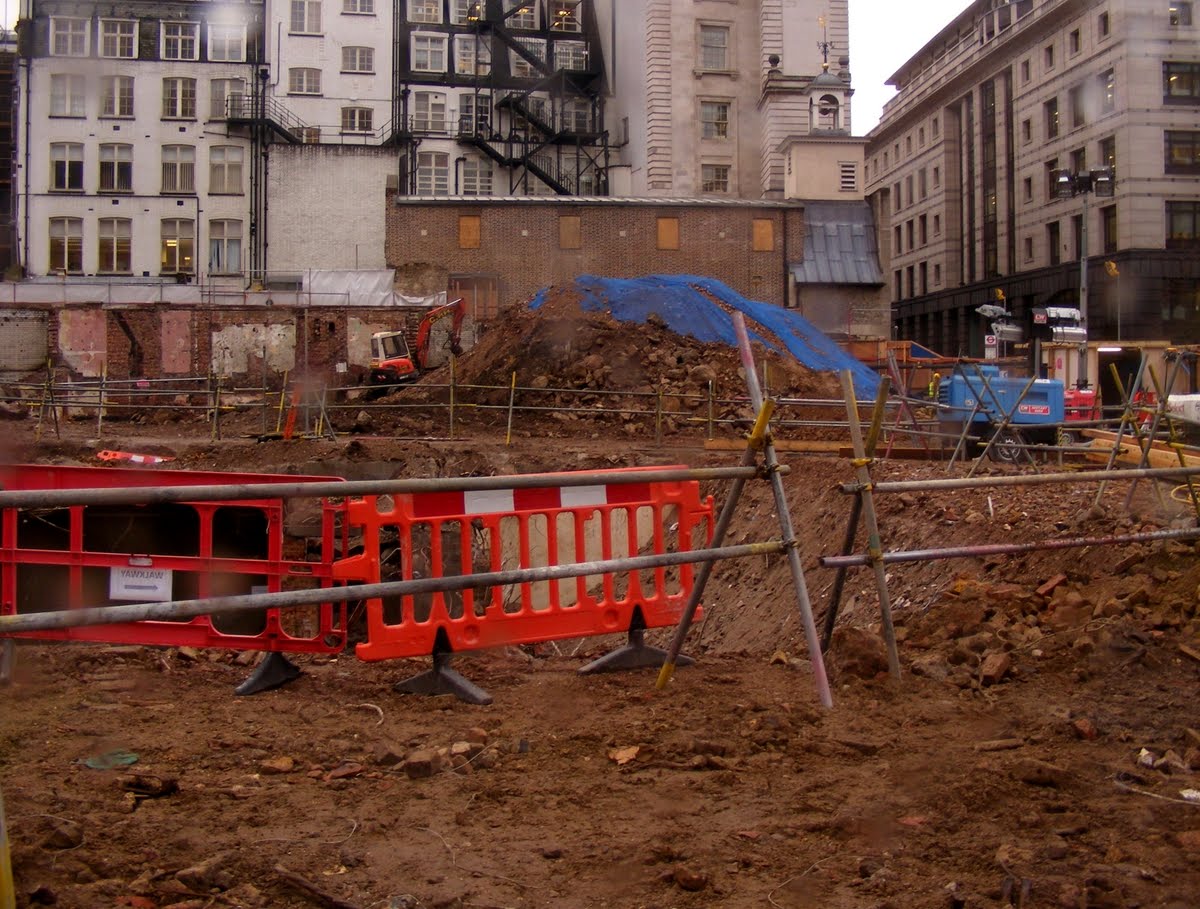
The last remains of Bucklersbury House. I think there's something by Norman Foster planned for the site: that's his Walbrook development on the right, so there'll be something of a Fosteropolis when it's all finished :

The corner of Ludgate Hill and Limeburner Lane. There was a building with an odd plasticky golden finish here before, like a slightly tarnished Quality Street wrapper:

Tuesday, 24 May 2011
Entombment and Entomology
In 1834 Henry Inwood published a pamphlet entitled Of the Resources of Design in the Architecture of Greece, Egypt, and other Countries, obtained by the Studies of the Architects of those Countries from Nature, which advanced the theory that the architects of antiquity evolved their forms from a close study of nature, suggesting that that the flutings of Doric columns were taken from reeds, mineral crystallisations or seashells, that Egyptian mummies were wrapped up in imitation of the cocoons of moths and that the image of the sphynx was inspired by a butterfly chrysalis.
I haven't seen the book, but a contemporary review provides long extracts. There's a morbid visionary quality to some of Henry's ideas, which ties in well with the wholly original emphasis on the crypt entrances at St Pancras:
...it would require not much philosophical reflection to observe that the chrysalis of the insect kingdom seemed a state between one existence and another: and, by wishing to apply so beautiful a type to their own being, produced the prototype for converting, by bandages and painted decorations, the human body, as to resemble a pupa or chrysalis; under an impression of its awaiting, in that chrysali state, its period of entering and rising to another existence.
It seems rather a pity that he never attempted the Egyptian style. It's not inconceivable: PF Robinson's Egyptian Hall in Piccadilly was built as early as 1812, but the style never really caught on. The idea of modelling a church on an ancient Egyptian temple isn't really stranger than modelling one on a Greek temple, but I don't know that anyone ever has.
I was going to contrast the practical William with the doomed poetic Henry William. But this hardly stands up; a little poking around in the parliamentary accounts, courtesy of Google Books turns up the fact that Henry William took on his father's post as Clerk of the Works to the improvements to the surroundings of the Palace of Westminster, holding it from around 1811 to at least 1826. Which all sounds very responsible.
Monday, 16 May 2011
A Pagan Place

William Railton's teacher, William Inwood, seems to have had a patchy career as an architect. According to the Dictionary of National he was born in around 1771, son of the bailiff at at Kenwood.He was trained as an architect and surveyor, and became steward to Charles Abbot, speaker of the House of Commons 1802-17, later created Lord Colchester. Inwood seems to have been a practical man. In 1811 he published a book called Tables for the Purchasing of Estates, Freehold or Copyhold Leasehold Annuities etc.. that went through many editions. The DNB tells us that he "designed numerous mansions, villas, barracks, and warehouses." This sentence seems to have been repeated unquestioningly from mid-nineteenth accounts of his life, but the actual locations of the mansions, villas, barracks, and warehouses remain obscure. From around 1806 he was clerk of the works to the "Commissioners for executing the several Acts for improvement of streets and places near to Westminster-Hall and the two Houses of Parliament". He was succeeded in this post by his son, Henry William Inwood, at the end of February 1812.
Inwood did some work on the church tower at East Grinstead - with which Abbot had close associations - and built the Westminster National Free Schools on some of the land conveniently cleared in the Westminster improvements. Then came his most famous building, St Pancras New Church, designed in 1818 in collaboration with Henry William Inwood, although only William's name is mentioned on the foundation stone. By the time of it's completion, however, it was acknowledged as a joint effort . It was a prestigious contract for a low-profile architect : at a cost of over £76,000, it was said to be the most expensive church built in London since the rebuilding of St Paul's Cathedral. The Inwoods came up with a design heavily influenced by the Erectheum in Athens, which Henry William visited at around this time (though probably after the basic plans for St Pancras had been drawn up) and of which he later published a study. It was widely seen as a radical advance in the accurate imitation of ancient Greek architecture. For a while, no-one seems to have thought this an odd ambition for an ecclesiastical architect.
William Inwood had two or possibly three sons who were also architects - Henry William born in 1794, and Charles Frederick, born in 1798 are well recorded. I've also come across a passing reference to a third, called Edward . William and Henry designed two more classical churches together - St Peter's, Regent Square (since demolished) and the Camden Chapel (later All Saints), Camden Town. They also collaborated on one in a sort of Gothick; St Mary's Somers Town, about which no architectural critic has ever had much positive to say. All three were in the parish of St Pancras. With Charles Frederick, William designed the Westminster Hospital of 1834-4, in a similarly basic Gothic.
Information about any other work seems hard to come by. He's credited with a house called Woburn Lodge which once stood next to St Pancras New Church, but Henry also claimed that in a letter to the father of a potential pupil.
Charles Frederick Inwood died in 1840 and William himself on March 16th 1843, at his house in Upper Seymour Street, Somers Town. Around this time - the exact chronology is obscure - Henry, whose career is said to have been hampered by illness, sold his collections of antiquities to the British Museum and sailed for Spain. He never arrived: the ship - the name of which I can't find mentioned anywhere - sank with the loss of all on board on March 20th.
Wednesday, 6 April 2011
The Tired Hunter
 Just thought I'd share this image from the box under my bed. It's one half of a stereoview of the Crystal Palace at Sydenham. The statue on the left is - as examination of the lettering on the pedestal with a magnifying glass reveals - "The Tired Hunter" by Edward Hodges Baily, of Nelson-on-the-Column fame. Actually, it's probably a just a plaster cast. The original marble was carved for Joseph Neeld of Grittleton House, Wiltshire. It was shown at the Royal Academy in 1851, under the title 'A Youth and his Dog', while a plaster cast was shown at the Great Exhibition at the Crystal Palace in Hyde Park. And no doubt it was the cast that followed the Palace south to Sydenham, where it was shown in the 'Mixed Fabrics Court ', while Neeld enjoyed the original in the privacy of his own home.
Subscribe to:
Posts (Atom)